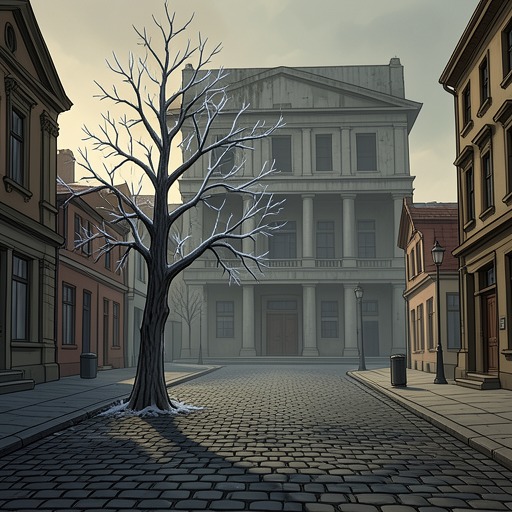
Jerusalem’s Lot Public Library
'Salem's Lot: A NovelJerusalem’s Lot Public Library is the town’s public archive, reading room, and storehouse of collective memory, but its significance changes radically as Jerusalem’s Lot is emptied and transformed by vampirism. At first it represents ordinary civic continuity: books circulate through the town, residents recognize one another through gossip and records, and the library’s holdings give the isolated community a connection to a larger literary world. By the later stages of the crisis, however, the building is closed, its third floor is sealed, and the librarian who once controlled access has become one of the undead. The library therefore condenses the novel’s movement from social knowledge to supernatural secrecy, from a place where the town reads its world to a place where the town’s dead continue to reside.
Civic Setting and Local Knowledge
The library belongs to a small, nearly circular Maine township whose roads, neighborhoods, schools, farms, river, cemetery, and commercial center form a tightly connected social map. Brock Street crosses Jointner Avenue at right angles, giving the town the appearance of a telescopic sight, while the surrounding quarters divide its population by landscape and class: wooded north Jerusalem, open agricultural land near the Royal River, established farms and commuter homes in the southeast, and the poorer trailers and shacks of the Bend in the southwest. The library exists within this network of roads, telephone lines, shops, churches, schools, and houses, and its importance derives from the way such institutions make a small town legible to itself. The town’s public life is sustained less by formal communication than by accumulated talk. Two-, four-, and six-party telephone lines ensure that residents are rarely without someone to discuss, while the town’s scandals simmer through households, stores, and gathering places. The library stands in contrast to this volatile oral network: its books and records offer durable forms of memory, even as the community continually reshapes facts into rumor. The surrounding towns’ early reports of a haunted ’Salem’s Lot, colored lights above the Central Maine Power lines, a possible dark coven, and comparisons with mass graves in Houston show how quickly missing persons become legend when ordinary explanations fail. The library is part of the civic apparatus that might have organized such knowledge, but the town’s disappearance prevents that process from becoming a reliable public investigation.
Books, Readers, and the Public Institution
The library is introduced through the circulation of books rather than through a formal description of its architecture. Susan Norton meets Ben Mears in the town park while reading Air Dance, Ben Mears’s second novel. The copy bears the stamp of Jerusalem’s Lot Public Library, identifying the institution as the channel through which the returning writer becomes visible to Susan before their relationship has begun. The library thus links private reading with public recognition: Susan encounters a book in which the author’s photograph is part of the object, then encounters the author himself. Ben’s joking remark that such an apparently inconsequential beginning could start dynasties acquires a prophetic force because the library has already made their meeting possible through the circulation of his work. The library also functions as evidence of Ben Mears’s status as a writer. When Parkins Gillespie is asked whether Ben is a real writer or merely a fraud, the answer rests on the fact that the library contains three of his books. The number matters because it makes authorship locally verifiable. Ben is not simply a stranger claiming a literary identity; his work has entered the town’s shelves and therefore its institutional memory. The exchange also captures the town’s skeptical humor: the question of whether the books are “True or made up?” receives the answer “Made up,” as though fiction were the only acceptable definition of a writer’s truth. The library’s holdings quietly establish Ben’s prior connection to Jerusalem’s Lot before his return turns that connection into an active confrontation with the town’s past. The institution’s most revealing material description comes through the earlier discovery of Hubert Marsten’s house. When townspeople enter the abandoned house after the excitement surrounding it, the building is found to be a chaotic accumulation of junk, scavenged objects, newspapers, magazines, and moldering books. Among the debris are complete sets of Dickens, Scott, and Mariatt, salvaged for Jerusalem’s Lot Public Library by Loretta Starcher’s predecessor. This detail gives the library a material history: its collection is not only purchased or formally donated but also rescued from the town’s private ruins. The books that once belonged to an isolated, dangerous household are absorbed into a civic institution, where they appear to become harmless cultural property. The movement also creates an unsettling connection between the Marsten House and the library, joining the town’s most charged private space to its public storehouse of knowledge.
Loretta Starcher and the Locked Third Floor
Loretta Starcher, the town librarian, embodies the library’s authority over access, classification, and hidden knowledge. The third floor is always kept locked, and Loretta alone possesses the key, which she wears on a chain around her neck. Entry requires a special dispensation, granted only to a supplicant who can persuade her that he is strong enough, intelligent enough, and moral enough to receive it. The library therefore contains an internal hierarchy: its public function is open and ordinary, but its highest level is governed by judgment and exclusion. The locked floor resembles a sealed chamber in a Gothic structure, not merely because it is physically inaccessible, but because the conditions for entering it are ethical as well as practical. The library’s disappearance from ordinary civic life accompanies Loretta’s disappearance. Eva Miller tries to telephone her after sensing that something terrible is happening, but the call rings repeatedly without answer. Eva knows that the library is closed on Mondays, yet the practical explanation does not resolve the unease; the absent librarian becomes one more sign that the town’s familiar systems have stopped functioning. Loretta has not simply left her post. She now inhabits the library’s dark, musty third floor, the very space she once guarded. The keeper of the threshold has become its prisoner and its resident. The transformation is described through the language of books. Loretta is called a first edition of another kind, still as mint as when she entered the world, with her “binding” never having been cracked. This pun turns the librarian into a textual object while preserving the institutional metaphor of the library. Her body is treated as a volume, but the joke is not merely decorative: the human keeper of books has herself become part of the collection, an undead artifact stored in the locked upper room. The library’s knowledge remains, but its guardian is no longer a custodian of the living community. She has been absorbed into the supernatural archive that the town cannot see.
Closure, Occupation, and the Library’s Afterlife
The library’s closure belongs to the larger civic abandonment of Jerusalem’s Lot. The town’s shops, the Municipal Building, the schools, and other public facilities are boarded up; even the new grammar school and the tri-town consolidated high school stand empty, while furnishings and books are moved to makeshift facilities in Cumberland. The absence of children makes the transfer especially stark: education can be relocated, but the town’s own population has ceased to participate in it. Against this broad evacuation, the library’s continued physical presence is ominous. Its doors may be closed, but the building is not empty. It remains occupied by Loretta and by the darkness that has overtaken the town. The library also participates in the novel’s tension between public ignorance and private knowledge. Residents hear rumors through newspapers, telephones, stores, and taverns, but the truth of the vampire outbreak remains inaccessible to most of them. Even when awake people turn on every light and search for religious symbols, they do not look out their windows. The library should be a place for looking outward through records and explanations, yet its locked upper floor reverses that function: knowledge is present but sealed away, while the supernatural uses the building as a hidden dwelling. When Ben Mears, Mark Petrie, and their allies prepare to confront Richard Straker, Father Donald Callahan proposes visiting the shop first so Ben can speak frankly with him and the others can observe his reaction. Their plan depends on exposing concealed knowledge through direct scrutiny, whereas the library dramatizes the opposite condition—truth enclosed behind a door no ordinary investigation has opened. In this way, Jerusalem’s Lot Public Library becomes more than a background location. It is a civic symbol whose meanings are rewritten by the catastrophe. Its stamped books connect strangers, validate a writer’s identity, and preserve the town’s cultural inheritance; its rescued volumes link public memory to the sinister Marsten House; its locked third floor converts moral judgment into Gothic confinement; and Loretta Starcher’s undead residence turns the archive into a mausoleum. The library survives as a structure when the town’s social world has vanished, but survival does not mean continuity. It has become the place where Jerusalem’s Lot’s knowledge, gossip, books, and dead are held together in a single sealed institution.